

What is IDD?
What are Intellectual and Developmental Disabilities?
Developmental disabilities is an umbrella term that includes many conditions - including intellectual disability, autism, epilepsy, and cerebral palsy - that start at birth or during childhood and impair a person's cognitive and adaptive abilities, physical abilities, or a combination.
Studies indicate a third or more of people with intellectual and developmental disabilities also have a co-occurring mental health condition.
But most important, people with developmental disabilities are our family members, neighbors, friends, classmates and co-workers. Disability is a natural part of life and its presence does not define someone. We all have assets and potential to contribute to the community, and we all benefit from inclusive settings designed for access and belonging.
Prevalence
DD Bill of Rights ActPrevalence rates vary depending on which conditions you count. If you include ADHD, learning disabilities, and chronic health conditions that affect children as they grow, about one in five people are affected.
Generally, though, the term intellectual and developmental disabilities (IDD) describes a much smaller group of people - 1.58 percent of the population - whose conditions align with the definition in the federal Developmental Disabilities Assistance and Bill of Rights Act.
Federal definition
The definition in the federal Developmental Disabilities Assistance and Bill of Rights Act of 2000 limits prevalence to people who have severe, chronic disabilities, which:
Are attributable to a mental or physical impairment or a combination of mental and physical impairments.
Originate at birth or during childhood.
Are expected to continue indefinitely.
Substantially restrict functioning in three or more major life activities, including:
- Self-care
- Receptive and expressive language
- Learning
- Mobility
- Self-direction
- Capacity for independent living, and
- Economic self-sufficiency
How many people have IDD?
If we use the 1.58 percent prevalence rate and census estimates, about 36,000 people in King County and 120,000 statewide likely meet this definition.
Many more, however, have a developmental condition that affects their ability to live independently and who rely on supports and accommodations to access the community.
What is meant by cognitive function?
Cognitive functioning includes:
- Learning
- Reasoning
- Thinking abstractly
- Applying learning on a variety of settings
- Problem solving
What is meant by adaptive behavior?
Adaptive behavior includes:
- Social interactions
- Receptive and expressive language
- Self-direction
- Daily practical skills
Resources
Would you like to learn more? Explore our website! We offer a resource guide, advocacy support, information and referral, and so much more. Many of our workshops are recorded and can be found in our video library.
Accessible and inclusive communities dismantle barriers
At The Arc of King County, we envision a world where individuals with intellectual and developmental disabilities thrive as equal, valued, and active community members.
We strive to dismantle barriers that limit people with intellectual and developmental disabilities. These are more than physical and include biased policy, stereotyping, lack of services, and destructive attitudes.
We believe that when people with intellectual and developmental disabilities live, learn, work, and play in the community we all benefit.
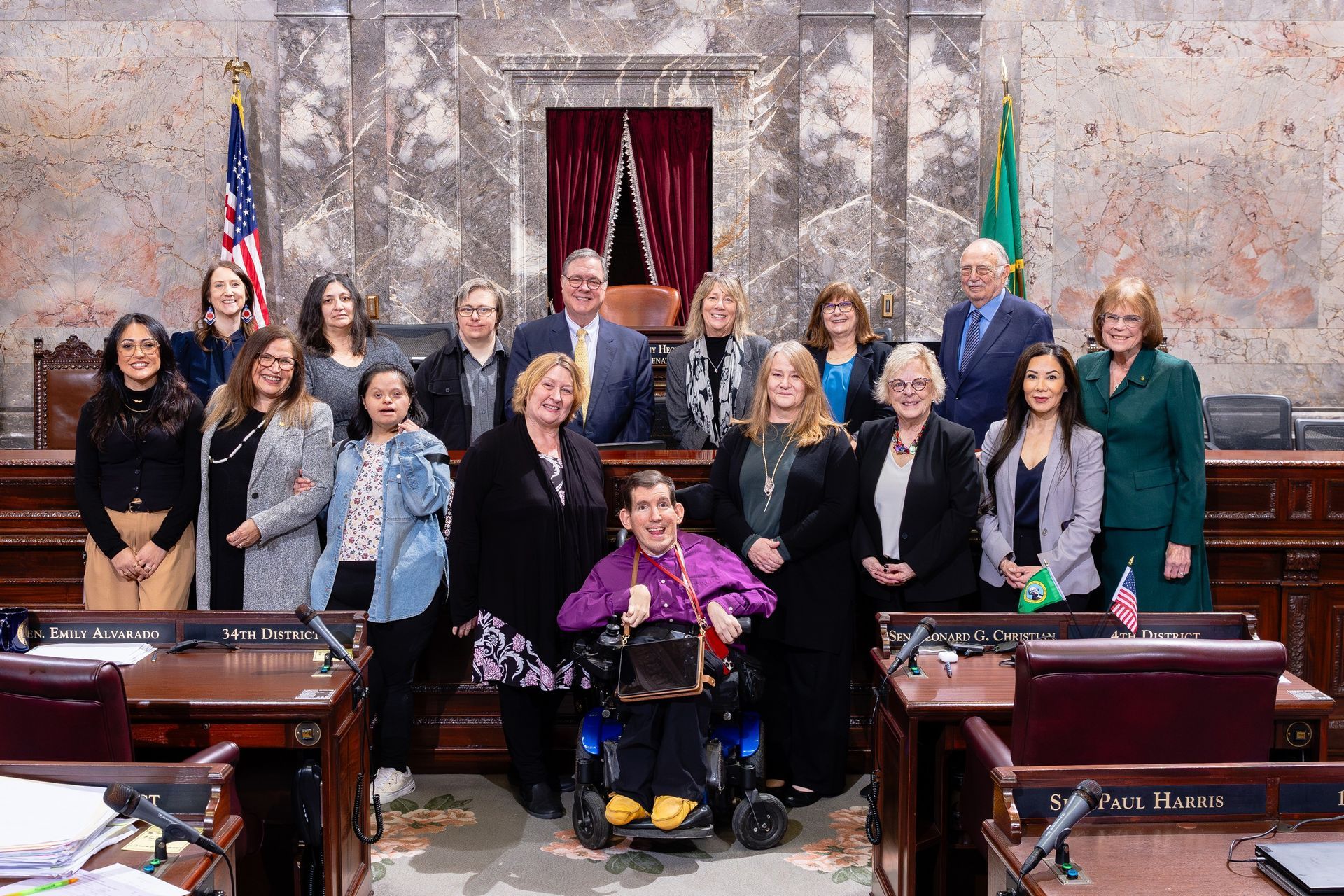
Advocates celebrate the 2026 proclamation making March "Developmental Disabilities Awareness Month" in Washington state.